
Administrative Law
Chapter 6 -
Part 4
TAKE HOME EXAM
1. Agency investigations are a process of gathering information.
2. An agency does not need jurisdiction to seek information.
3. Privileged information is between two judges.
4. The enabling act established the agency’s jurisdiction.
5. A regulatory agency may review business records.
6. The Atomic Energy Commission decides which businesses should keep wage and hour records.
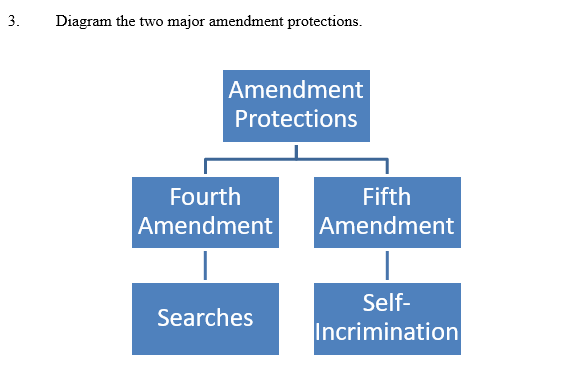
7. The Fourth Amendment protects against self-incrimination.
8. Agencies limit inquiry intrusions to reasonable means.
9. A subpoena orders a person to testify at a hearing.
10. With a search warrant, an agency has unlimited search powers
(Scroll down for answers)
TAKE HOME EXAM ANSWERS
TRUE 1. Agency investigations are a process of gathering information.
FALSE 2. An agency does not need jurisdiction to seek information.
FALSE 3. Privileged information is between two judges.
TRUE 4. The enabling act established the agency’s jurisdiction.
TRUE 5. A regulatory agency may review business records.
FALSE 6. The Atomic Energy Commission decides which businesses should keep wage and hour records.
FALSE 7. The Fourth Amendment protects against self-incrimination.
TRUE 8. Agencies limit inquiry intrusions to reasonable means.
TRUE 9. A subpoena orders a person to testify at a hearing.
FALSE 10. With a search warrant, an agency has unlimited search powers
Three Venues of Research
1. In Book: Research the Fourth Amendment. Include Camara, Burger, and
Scott. (pages 204-206)
Reasonable search; Camara – Agency search warrant (homes)
Burger – warrantless inspections, agency search warrant
Scott – the right for an agency search without warrant is narrow
2. At Library: (a) The Equal Employment Opportunity Commission (EEOC) is the focus of EEOC v. Kloster. Look up EEOC’s rules for information gathering in the Code of Federal Regulations. Then look up the full case, EEOC v. Kloster, and write a report of any insights you gained. Federal Code of Regulations,939 F.2d 921 (11th Cir. 1991)
OR
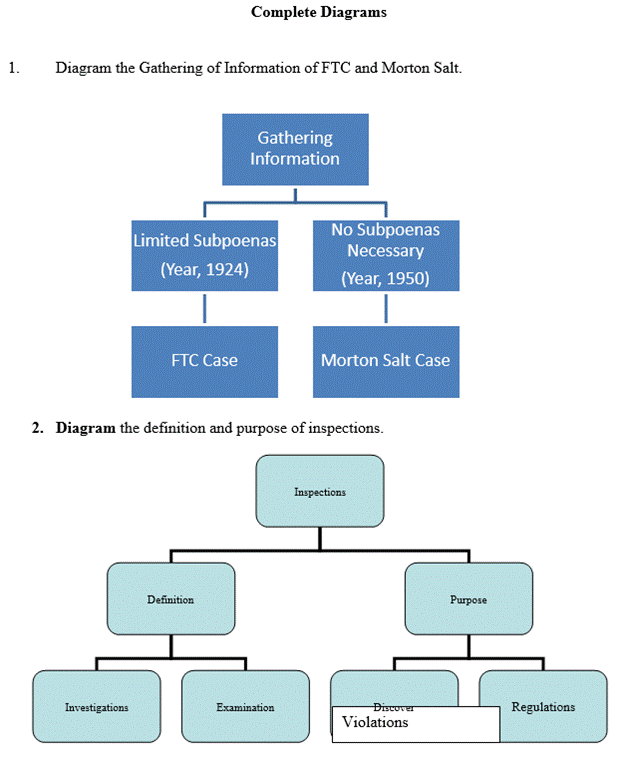
- United States v. Morton Salt (1950) changes the view of agency access to
information from the time of FTC v. American Tobacco (1924). Research the
nation’s lifestyle and thinking in 1924 and in 1950. History books, videos
On Internet: Look up the U.S. Supreme Court. Write a biographical report on a
Justice.
www.uscourts.gov
Internship
The law firm has a small business as a client. The lawyers will be appearing at a hearing with the client at the U.S. Department of Labor.
Your assignment is to research the U.S. Codes and the Code of Federal Regulations for any information on the Labor Department’s ability to issue subpoenas and search warrants. Write a memo covering any pertinent facts and cites.
U.S. Codes and Federal Code of Regulations/ www.dol.gov